
Among the many cultural milestones that define life in Myanmar, few carry as much spiritual, social, and emotional significance as shinbyu. This sacred rite of passage marks a young boy's temporary entry into monastic life, following in the footsteps of Prince Siddhartha when he renounced his royal life to seek enlightenment. For Burmese families, the shinbyu ceremony is not simply a religious event but one of the most important occasions in their lifetime, often planned years in advance and celebrated with the full participation of the community. Travelers who include cultural immersion in their Myanmar tours itineraries frequently describe witnessing a shinbyu as one of the most moving and memorable experiences the country has to offer. This guide covers everything you need to know about this profound Buddhist tradition, from its ancient roots to its living practice today.
What Is Shinbyu?
Shinbyu is the Burmese word for the novitiation ceremony in which a young boy temporarily becomes a novice Buddhist monk, known as a "koyin" or "samanera." The ceremony marks the formal initiation of a male child into the Theravada Buddhist tradition, symbolizing his acceptance of the Buddha's teachings and his first meaningful commitment to the path of spiritual development.
The word shinbyu itself is derived from Burmese terminology associated with the act of "making a shin," where "shin" refers to a novice monk. At its core, the ceremony is a re-enactment of the historical moment when Prince Siddhartha Gautama, the future Buddha, left behind his life of royal privilege to pursue spiritual truth. The boy is dressed as a prince before the ceremony begins, symbolizing the wealth and comfort he is temporarily renouncing in favor of monastic simplicity.
Unlike other religious coming-of-age ceremonies found around the world, shinbyu is understood not as a permanent commitment but as a spiritually meritorious act that benefits the boy, his family, and the wider community. It is considered an act of tremendous merit for the parents in particular, as facilitating their son's entry into the monkhood is one of the highest forms of Buddhist generosity they can offer.
The Origins and History of Shinbyu
The roots of shinbyu stretch back to the earliest centuries of Theravada Buddhism in mainland Southeast Asia. As Buddhism spread from Sri Lanka into the Mon kingdoms of lower Burma, and later flourished under the great Pagan Empire beginning in the 9th century, the practice of novice ordination became embedded in the spiritual life of Burmese communities.
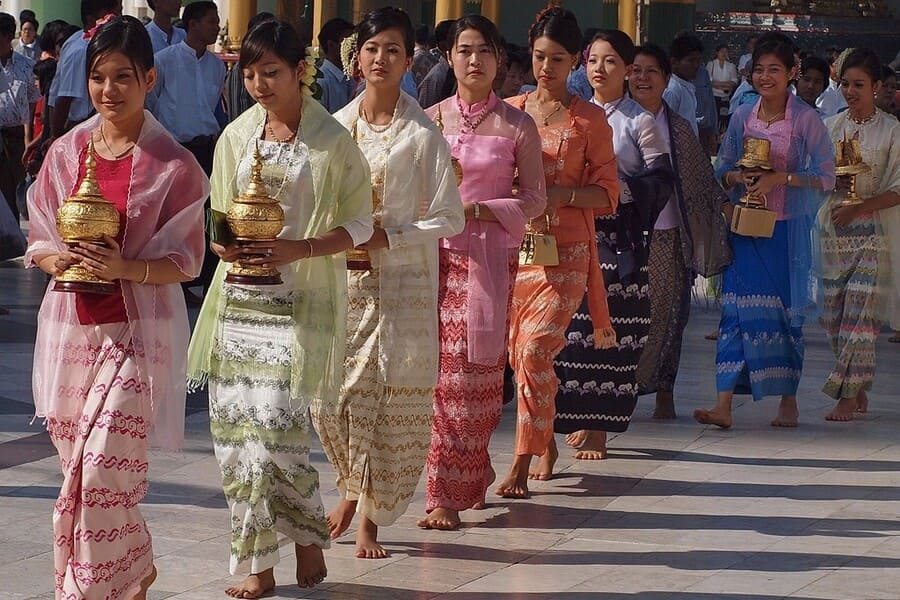
The tradition draws directly from the Vinaya, the ancient code of monastic discipline established by the Buddha himself, which outlines the rules and procedures for ordaining monks and novices. Over centuries, the Burmese people developed their own rich cultural expressions around this core Buddhist framework, adding elaborate processions, royal costumes, music, feasting, and community celebration to what was originally a more austere religious rite.
By the time of the great Burmese kingdoms of Bagan, Inwa, and Mandalay, the shinbyu ceremony had become one of the defining events of Burmese social life. Royal shinbyu celebrations at court were grand affairs lasting several days, with lavish processions and performances that the entire capital would gather to witness. This royal association remains embedded in the ceremony's visual language today, particularly in the tradition of dressing the boy as a prince.
Even through periods of colonial disruption, civil conflict, and political upheaval, the shinbyu tradition has remained a constant and vibrant thread in Myanmar's social fabric. It is practiced by Burmese Buddhists across all regions of the country and among diaspora communities worldwide.
Who Can Participate in a Shinbyu Ceremony?
Typical Age for Shinbyu
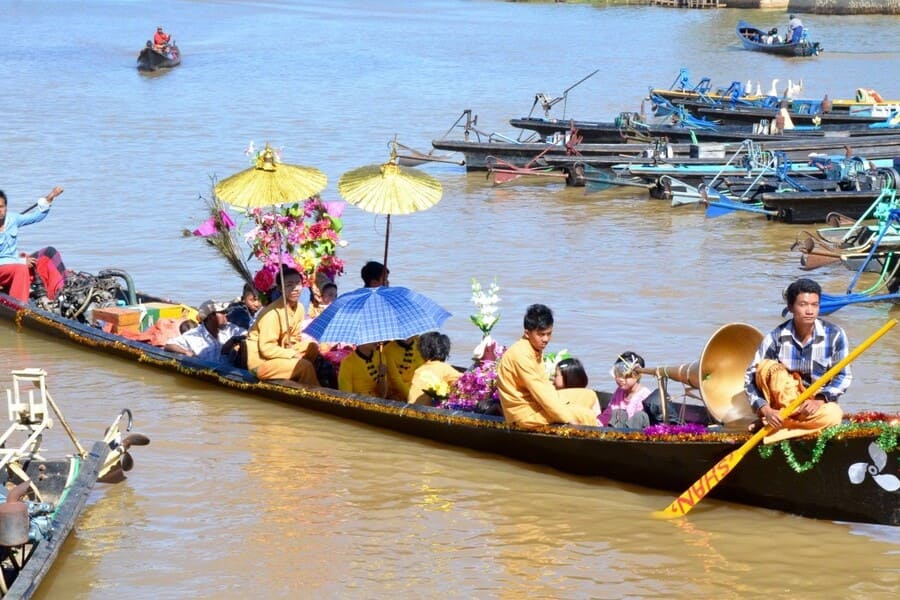
A shinbyu is traditionally performed for boys between the ages of five and fifteen, with the most common age falling between seven and twelve. There is no single prescribed age, and families often coordinate the timing based on practical considerations, auspicious dates recommended by an astrologer, and the availability of relatives who wish to attend.
In some families, particularly those with fewer financial resources, multiple sons may be ordained together in a single combined shinbyu ceremony to reduce costs while maximizing the merit accumulated. This is entirely acceptable within Buddhist custom and often results in especially joyful celebrations.
How Long Do Novices Stay at the Monastery?
The length of time a boy spends as a novice monk varies considerably. Some boys remain at the monastery for as little as three days, while others stay for one week, one month, or even longer depending on family preference, the boy's own experience, and the capacity of the monastery to accommodate novices.
During significant Buddhist holidays, particularly Lent (Vassa), which falls during the rainy season from roughly July to October, many families choose to have their sons ordained for the full duration of the retreat period. This is considered especially meritorious and aligns the boy's novice period with one of the most sacred seasons in the Theravada Buddhist calendar.
Can a Boy Participate More Than Once?
Yes, a boy can participate in a shinbyu more than once. While most boys undergo the ceremony once during childhood, there is no religious restriction against repeated ordinations. Some young men choose to undergo novice ordination again as teenagers or young adults, and a significant number of Burmese men also undergo full monk ordination at some point in adult life. Each ordination is considered a fresh accumulation of merit for the individual and his family.
Preparations for a Traditional Shinbyu Ceremony
Choosing an Auspicious Date
One of the first and most important steps in planning a shinbyu is consulting a trusted astrologer or senior monk to identify an auspicious date for the ceremony. In Burmese Buddhist culture, the alignment of the calendar, lunar cycles, and the boy's birth chart are all considered relevant to choosing a date that will bring positive outcomes.
Certain months and lunar days are traditionally preferred for shinbyu ceremonies, particularly those that fall within the cooler dry season between November and February. Families often book their preferred monastery and inform their extended community many months in advance.
Invitations and Community Involvement
A shinbyu ceremony is never a private family affair. It is fundamentally a community event, and invitations are extended broadly to neighbors, colleagues, friends, distant relatives, and often the wider village or neighborhood. In rural communities, essentially the entire village may be involved in preparations and attendance.
Invitations were traditionally delivered in person or via printed cards, and it remains customary to show up in person to inform people of the upcoming celebration. The community's participation is not merely social but spiritual; the presence of witnesses increases the merit generated by the event for all involved.
Traditional Costumes and Accessories
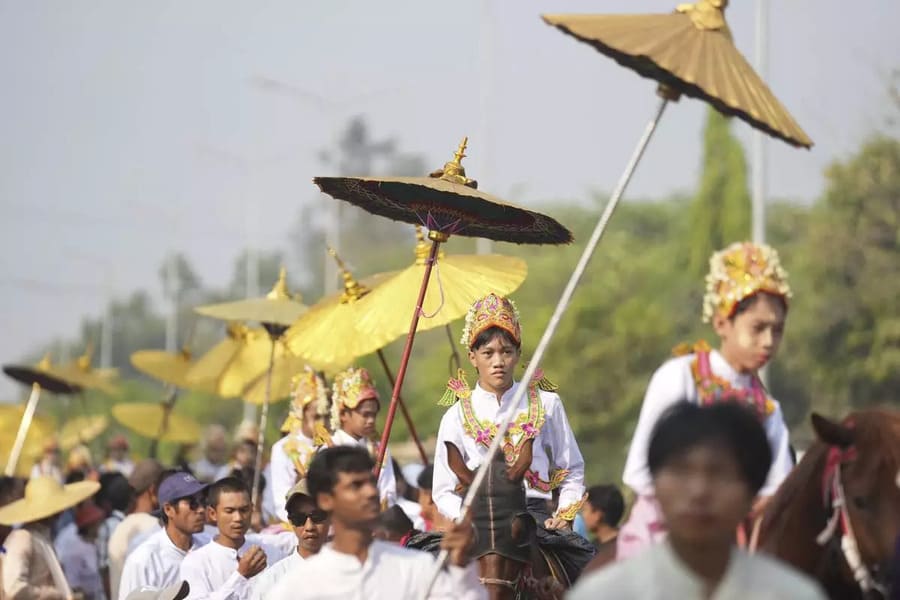
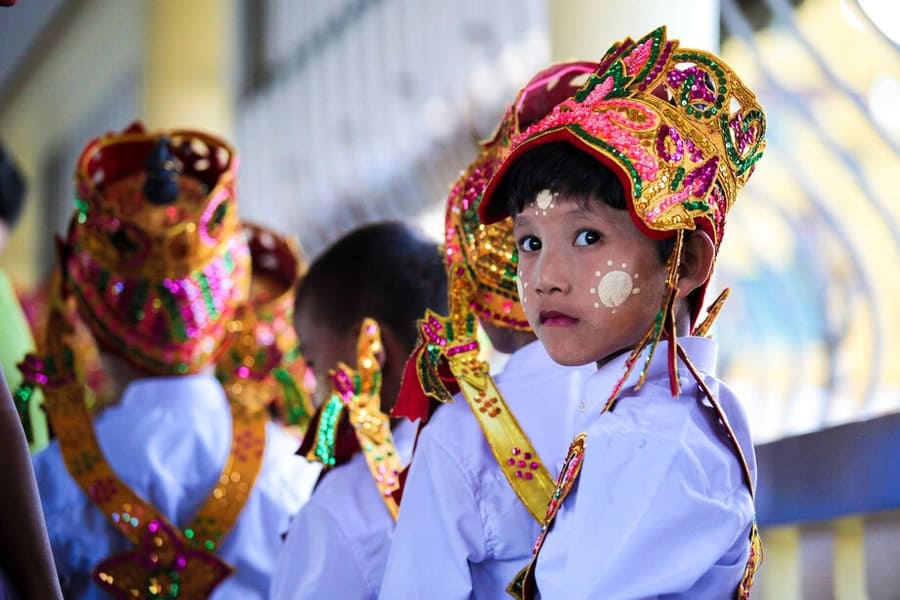
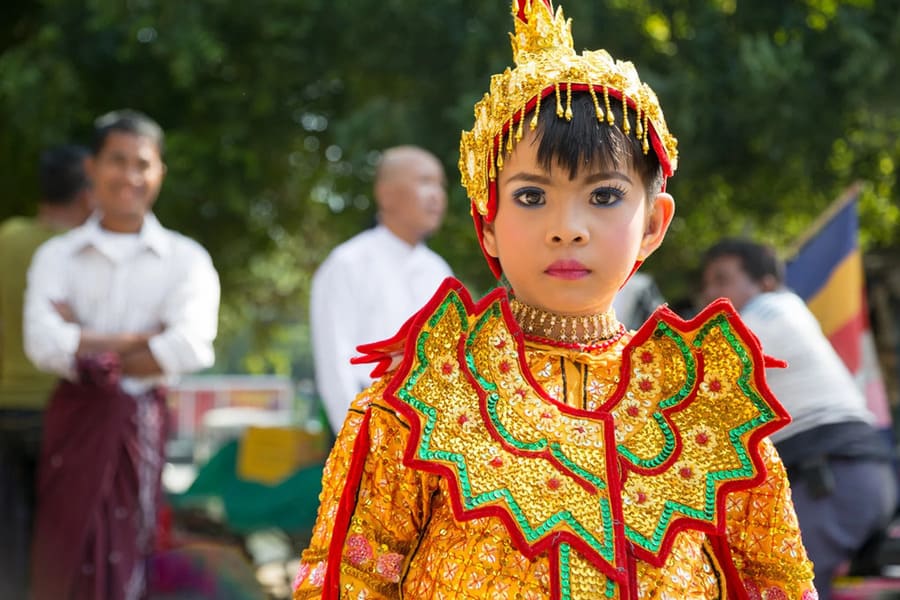
The preparation of the boy's ceremonial costume is one of the most visually spectacular aspects of shinbyu. In the days before the ceremony, the boy is dressed in elaborate royal attire modeled on traditional Burmese court dress. This typically includes a richly embroidered longyi (traditional wrapped garment), an ornate jacket, a headdress or golden crown, and elaborate jewelry including rings, necklaces, and earrings.
The symbolism is intentional: the boy is dressed as a prince to mirror the story of Prince Siddhartha, and the ceremony will culminate in him voluntarily setting aside this royal splendor in favor of the simple saffron robes of a novice monk. The contrast between the two states forms the visual and spiritual heart of the entire shinbyu ceremony.
The Main Stages of a Shinbyu Ceremony
The Grand Procession (Shinlaung Procession)
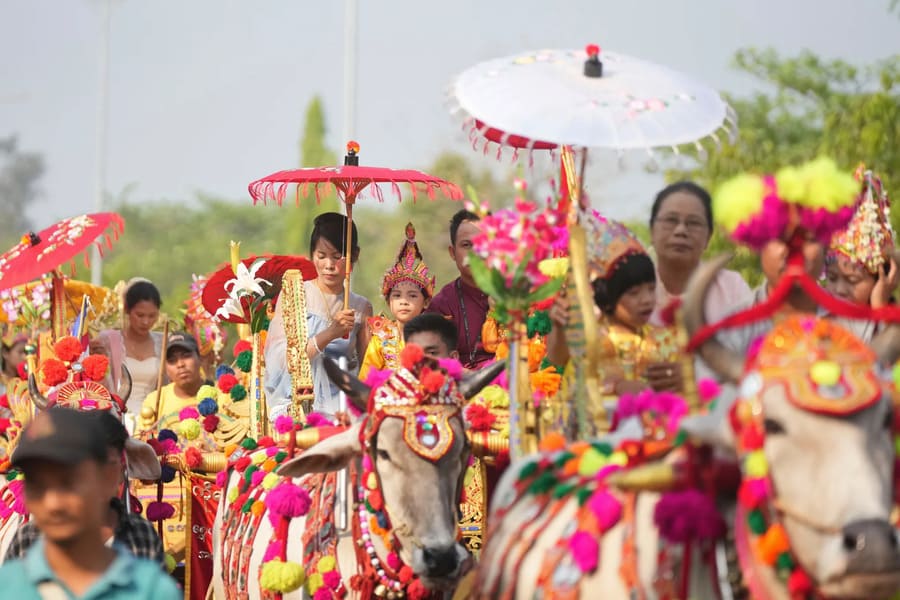
The shinbyu celebration typically begins with a grand procession through the neighborhood or village, known as the Shinlaung procession. The boy, dressed in his full princely regalia and often seated on a decorated horse or carried in an ornamented palanquin, is accompanied by family members, musicians playing traditional Burmese instruments, dancers, and a large crowd of well-wishers.
This procession is one of the most joyful and visually vibrant moments of the entire shinbyu ceremony, drawing onlookers from surrounding areas who may not have been formally invited but gather to celebrate and accumulate merit by witnessing the event.
Paying Respect at the Pagoda
Before heading to the monastery, the procession typically stops at a significant local pagoda or Buddhist temple to pay respects and make offerings. This step honors the Buddha's teachings and formally places the ceremony within the context of the broader Buddhist community and tradition.
The family presents offerings of flowers, candles, and incense at the pagoda's altar, and the boy prostrates himself before the image of the Buddha as a sign of reverence and humility.
Hair-Shaving Ritual
One of the most emotionally significant moments of the shinbyu ceremony is the shaving of the boy's head. Before the shaving begins, a senior female family member, often the grandmother or mother, ceremonially cuts the boy's hair. This initial symbolic cutting is then followed by the complete shaving of the head by a monk or barber.
The shaving represents the renunciation of vanity and attachment to physical appearance, one of the foundational principles of monastic life. Mothers and grandmothers are often visibly moved during this stage, and it is not unusual for tears to flow as the boy's hair falls away and he begins to visibly transform from a prince into a novice.
Taking the Ten Precepts
After the head-shaving, the boy formally requests ordination from the presiding monks by reciting the Ten Precepts in Pali, the sacred language of Theravada Buddhism. These precepts outline the ethical commitments of a novice monk, including abstaining from taking life, stealing, sexual misconduct, false speech, intoxicants, eating after midday, entertainment, wearing garlands and perfumes, using high seats, and accepting gold and silver.
The recitation of these precepts in Pali is a deeply meaningful act, connecting the young boy to an unbroken lineage of Buddhist practitioners stretching back over two and a half thousand years.
Receiving the Monastic Robes
Following the recitation of precepts, the boy is presented with the saffron robes of a novice monk. The robes are typically offered by the parents and close family members, and the act of giving them is itself considered a deeply meritorious offering. The boy dresses in the robes with assistance, completing the visual transformation from bejeweled prince to humble novice.
Official Novice Ordination
The formal ordination is completed in the presence of the senior monks of the monastery, who chant Pali scriptures and formally accept the boy as a novice member of the sangha, the Buddhist monastic community. This moment is the spiritual culmination of the entire shinbyu ceremony and is treated with great solemnity and reverence by all in attendance.
Why Are Boys Dressed Like Princes During Shinbyu?
The tradition of dressing boys as princes during shinbyu is one of the most distinctive and frequently asked-about aspects of the ceremony. The answer lies at the heart of the shinbyu's symbolic meaning.
The ceremony re-enacts the life story of Prince Siddhartha Gautama, who was born into a royal family of great wealth and privilege before voluntarily giving up all of it to seek enlightenment. By dressing the boy as a prince, the family places him symbolically in the same position as the future Buddha, about to make the same act of renunciation.
Even if the family is of modest means, the shinbyu costume represents the highest status and luxury available to them. The subsequent transformation into the simple robes of a novice monk makes the symbolic renunciation tangible and emotionally powerful for everyone present. This contrast is not theatrical but deeply theological, illustrating the Buddhist teaching that true spiritual wealth lies not in material possessions but in the cultivation of wisdom and compassion.
Traditional Elements of a Shinbyu Myanmar Celebration
Music and Dance Performances
A traditional shinbyu Myanmar celebration is accompanied by live performances of classical Burmese music and dance. Professional troupes or community performers entertain guests throughout the evening before the ceremony and sometimes into the night. Performances may include traditional puppet theater (yama zatpwe), classical Burmese dance-drama, and live orchestras playing with the distinctive instruments of the Burmese hsaing waing ensemble, including gong circles, drums, and woodwind instruments.
Decorative Processions with Horses and Carts
The procession element of shinbyu Myanmar celebrations often features elaborately decorated horses, carts, and sometimes elephants in more traditional rural celebrations. The boy rides at the center of the procession, elevated above the crowd, while family members and community members walk alongside carrying offerings, parasols, and ceremonial fans.
Community Feasts and Donations
Hosting a shinbyu comes with a significant tradition of generosity. The family provides food for all guests across the full duration of the celebration, which may span one to three days. In addition, donations of food, robes, and other necessities are made to the monastery and to monks in the wider community. This spirit of dana, or generosity, is integral to the ceremony's merit-making purpose.
What Happens After the Ordination?
Daily Life as a Novice Monk
Once ordained, the boy joins the daily rhythm of monastic life. He wakes before dawn, participates in morning chanting sessions, and joins the monks on their alms round through the surrounding community. The simplicity of monastic routine stands in deliberate contrast to the elaborate celebrations that preceded it.
Learning Buddhist Teachings
During his time at the monastery, the novice begins to learn foundational Buddhist teachings under the guidance of senior monks. He studies Pali, learns key suttas (scriptures) by heart, and receives instruction in meditation and ethical conduct. Even a short stay at the monastery offers a boy a meaningful introduction to Buddhist practice that shapes his character and values for life.
Returning to Family Life
When the novice period ends, the boy returns to his family and resumes his ordinary life. The experience is understood not as a permanent transformation but as a formative spiritual foundation. Many Burmese men describe their childhood shinbyu as one of the defining experiences of their lives, regardless of how actively they practice Buddhism in adulthood.
Frequently Asked Questions About Shinbyu
What does Shinbyu mean?
Shinbyu is a Burmese word meaning the act of making someone a novice monk. It refers specifically to the novitiation ceremony in which a young boy is ordained as a temporary member of the Buddhist monastic community.
How long does a shinbyu ceremony last?
The celebration surrounding a shinbyu ceremony typically lasts between one and three days, with the formal ordination taking place on the final day. The boy's period as a novice at the monastery may last anywhere from three days to several months depending on family tradition and personal choice.
Is shinbyu only for boys?
Yes, shinbyu specifically refers to the male novitiation ceremony. However, girls in Myanmar can participate in a parallel ceremony known as "na twin," in which their ears are pierced as a spiritual rite of passage. While na twin shares some ceremonial similarities with shinbyu, it does not involve monastic ordination, as full ordination for women is not practiced in the Theravada tradition as observed in Myanmar.
Can tourists attend a shinbyu ceremony?
Tourists can attend a shinbyu ceremony if they are respectfully invited or if they receive an invitation through local contacts or a culturally knowledgeable guide. Burmese families are generally generous in welcoming visitors who approach with genuine respect and interest. The most important considerations are to dress modestly, behave quietly during the formal religious portions, follow the cues of local attendees, and never photograph people without permission.
When is the best time to witness a shinbyu ceremony in Myanmar?
Shinbyu ceremonies take place throughout the year, but the highest concentration of celebrations occurs during the cooler and drier months between November and February, when outdoor celebrations are most comfortable and many families have the financial resources available after the harvest season. The period just before and just after Buddhist Lent (Vassa) is also popular. Travelers who wish to witness a shinbyu ceremony should ask their local guide or hotel in advance, as ceremonies are community events that require some notice to attend respectfully.