
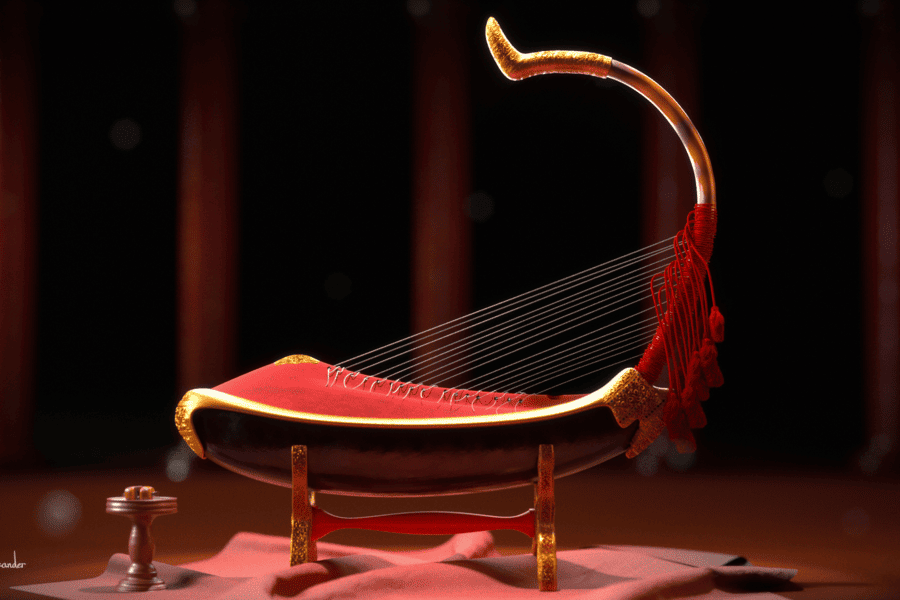
Anyone who has spent time exploring the temples of Bagan or the golden stupas of Yangon has likely heard the delicate, cascading tones of the Saung Gauk drifting through a courtyard or a quiet restaurant corner. This arched harp is far more than background music for travelers; it is the living voice of Burmese classical tradition, an instrument that has survived royal courts, colonial rule, and modern upheaval while still sounding today exactly as it did centuries ago. For visitors booking Myanmar tours that go beyond the usual temple checklist, learning about the Saung Gauk instrument offers a genuine window into the country's soul. This guide draws on documented history, museum records, and firsthand cultural context to give you a trustworthy, in-depth look at Myanmar's most treasured instrument.
What Is the Saung Gauk?
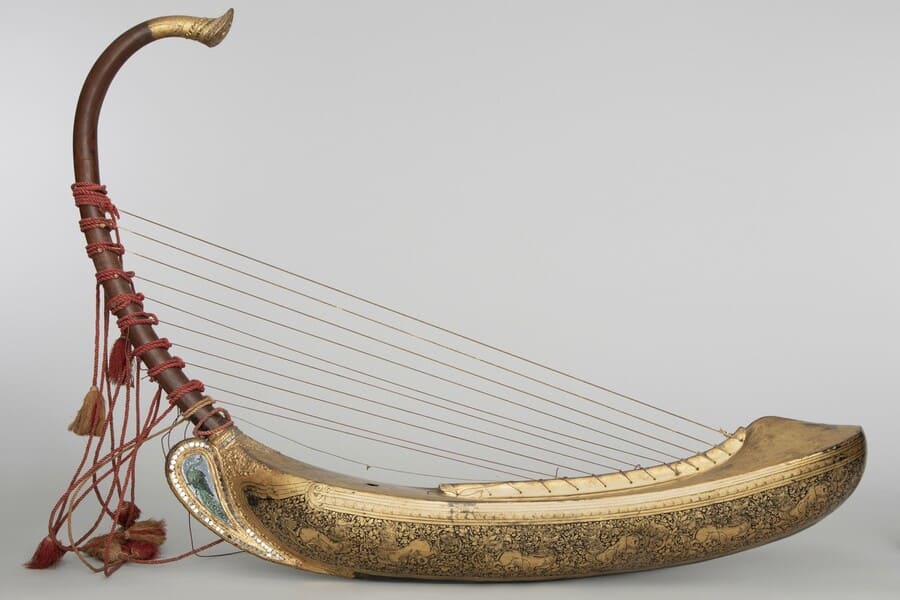
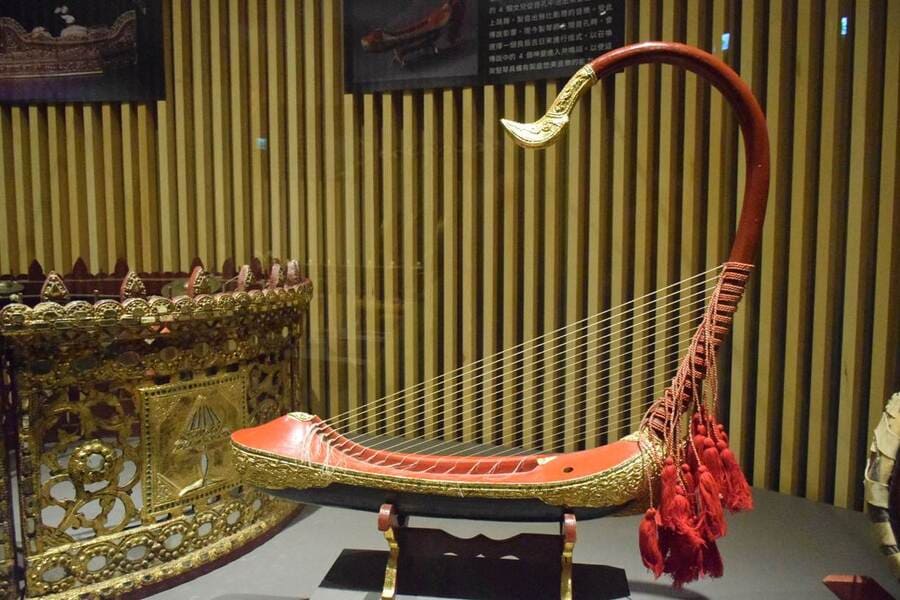
The Saung Gauk, sometimes written as saung-gauk or simply called the "saung," is an arched harp that holds the official title of national musical instrument of Myanmar. Unlike the vertical harps familiar to Western audiences, the saung gauk myanmar tradition uses a horizontal, boat-shaped resonator paired with a long, gracefully curved neck, giving the instrument its unmistakable silhouette.
What makes this harp genuinely remarkable is its rarity. Historians and organologists widely regard it as the only surviving harp tradition in Asia, a lineage that has continued uninterrupted for well over a thousand years while similar harps elsewhere in the region disappeared. Standing roughly 80 centimeters long with an arch rising about 60 centimeters from the body, the instrument is compact enough to be held in the lap, yet its sound carries a surprising depth and shimmer that fills a room without amplification.
Because of this cultural significance, the Saung Gauk appears not only in concert halls and cultural shows but also in temple carvings, court paintings, and modern tourism branding across the country, making it one of the most recognizable symbols of Burmese identity.
The History of the Saung Gauk
The story of the Saung Gauk stretches back further than most visitors expect. Archaeological evidence, including a sculpted relief at the Bawbawgyi Pagoda near Pyay dating to the mid-600s, shows an arched harp with about five strings, suggesting the instrument may have been introduced from southeastern India as early as 500 AD. Chinese chronicles from the same era even record Pyu musicians performing on an arched harp, and a Pyu diplomatic mission to China in the early ninth century documented an orchestra that included this same instrument.
The harp's name has been found inscribed at the ancient temples of Bagan, confirming its continuous presence through the centuries. During the Konbaung Dynasty, the saung gauk became firmly established as a royal court instrument, closely associated with elegance, education, and refinement. Female harpists in particular held prestigious positions within the royal household, and mastery of the instrument was considered a mark of noble upbringing.
One of the most influential figures in its development was the courtier Myawaddy Mingyi U Sa (1766–1853), who expanded the instrument's range from seven to thirteen strings, spanning two and a half octaves, and improved its structural strength by using the curved root of the sha tree. Later innovators added further strings: the last royal court harpist, U Maung Maung Gyi, introduced a fourteenth string in the early twentieth century, and post-independence musician U Ba Than standardized a sixteen-string version in the 1960s that remains common today.
The instrument nearly faded into obscurity before World War II, but a determined revival effort, including the founding of Myanmar's State Schools of Fine Arts around 1962, ensured that the Saung Gauk survived into the modern era. Today it is closely tied to the Mahagita, the classical vocal and instrumental repertoire of Myanmar, and cultural authorities have been working toward UNESCO recognition of this tradition as intangible cultural heritage.
The Price of Saung-Gauk
Travelers curious about bringing home a piece of this heritage often ask about the price of a saung-gauk, and the honest answer is that it varies enormously depending on craftsmanship and intent.
Small decorative souvenir harps, designed purely as ornaments rather than playable instruments, typically sell for modest amounts, often in the range of twenty to fifty US dollars, and are widely available in markets and gift shops in Yangon, Mandalay, and Bagan. These are lovely keepsakes but are not built for genuine musical performance.
Mid-range, handcrafted harps intended for students or serious hobbyists made with proper padauk wood bodies, sha tree root necks, and stretched deer or goat hide tend to cost considerably more, often falling somewhere between one hundred and several hundred US dollars, depending on the level of decoration and the reputation of the workshop.
Museum-quality or antique Saung Gauk instruments, particularly nineteenth and early twentieth century pieces with intricate lacquer work, mica inlay, and gold gilding, are valued far higher and are typically sold through specialist auction houses rather than local shops, sometimes reaching several hundred to over a thousand US dollars depending on provenance and condition. If you plan to purchase one seriously, it is worth having a knowledgeable local guide or a reputable instrument workshop verify the materials and craftsmanship before you buy, since quality varies significantly between vendors.
How the Saung Gauk Instrument Is Made
Traditional materials and craftsmanship
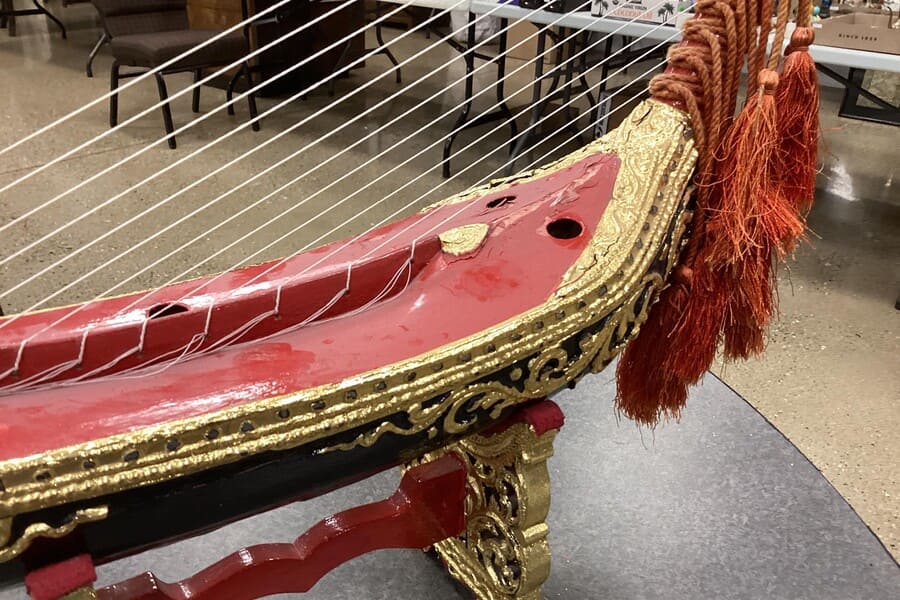
The construction of a genuine saung gauk instrument reflects centuries of refined craftsmanship passed down through generations of woodcarvers and instrument makers. The resonator, or body, is traditionally hollowed from a single block of padauk wood, a dense and richly grained timber prized throughout Southeast Asia. The top of this body is covered with tightly stretched deerskin, which is then heavily lacquered, often in a deep red, and pierced with four small circular sound holes that allow the tone to resonate outward.
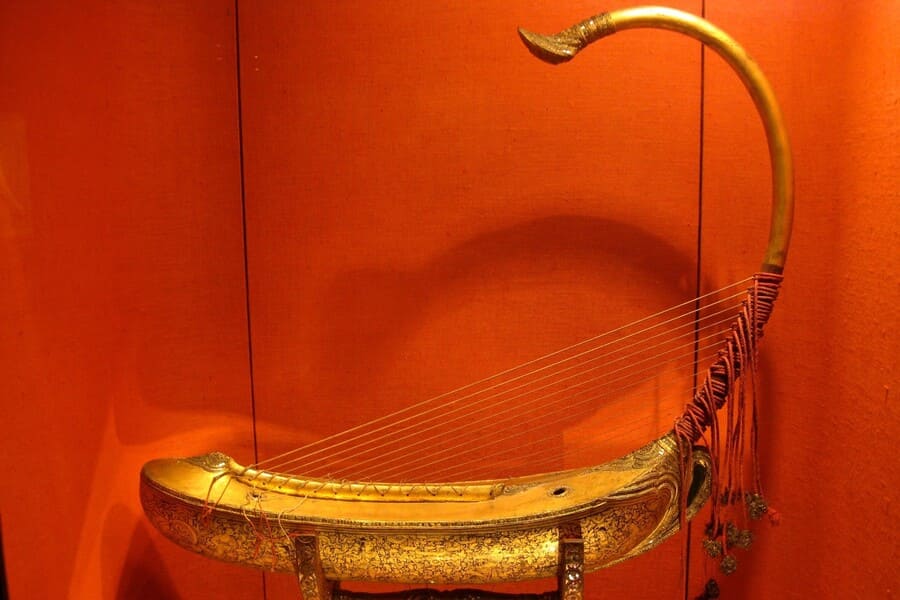
The instrument's iconic curved neck is carved from the naturally arching root of the sha tree, chosen specifically because its organic curvature provides both strength and the elegant bow shape the harp is known for. This attention to selecting wood with the right natural growth pattern, rather than forcing a shape through steaming or bending, is part of what gives each Saung Gauk its individual character.
Unique design and structure
Structurally, the saung gauk is classified as a horizontal arched harp, distinguishing it from vertical harps found in Western or African traditions. The body lies across the player's lap, with a string bar running down its center where the strings are anchored before angling upward to the curved neck. The neck itself terminates in a stylized leaf shape, widely believed to represent the leaf of the Bodhi tree under which the Buddha achieved enlightenment, a detail that reflects the deep intertwining of Buddhist symbolism and Burmese musical culture.
Decoratively, the finest examples are adorned with pieces of mica, sometimes nicknamed "Mandalay pearls," alongside gilt work, mirrored glass, and red and black lacquer patterns, occasionally depicting scenes from classical literature such as the Ramayana. The strings terminate in red cotton tassels, adding a final decorative flourish that is instantly recognizable in Burmese cultural imagery.
Number of strings and tuning
Early historical harps carried as few as five to eleven strings, but the standard configuration evolved considerably over time. Nineteenth century court harps commonly had thirteen strings, and by the mid-twentieth century, master craftsman U Ba Than helped standardize a sixteen-string version that remains widely used in contemporary performance and teaching.
Traditionally, the silk strings of the saung-gauk were tuned by carefully twisting and adjusting cotton bindings wrapped around the neck, a method requiring patience and a trained ear. Modern instruments increasingly use machine tuning pegs for convenience, though many traditionalists and cultural institutions still prefer silk strings and hand-tied tuning for authenticity, even as nylon strings have become more common for durability.
How Is the Saung Gauk Played?
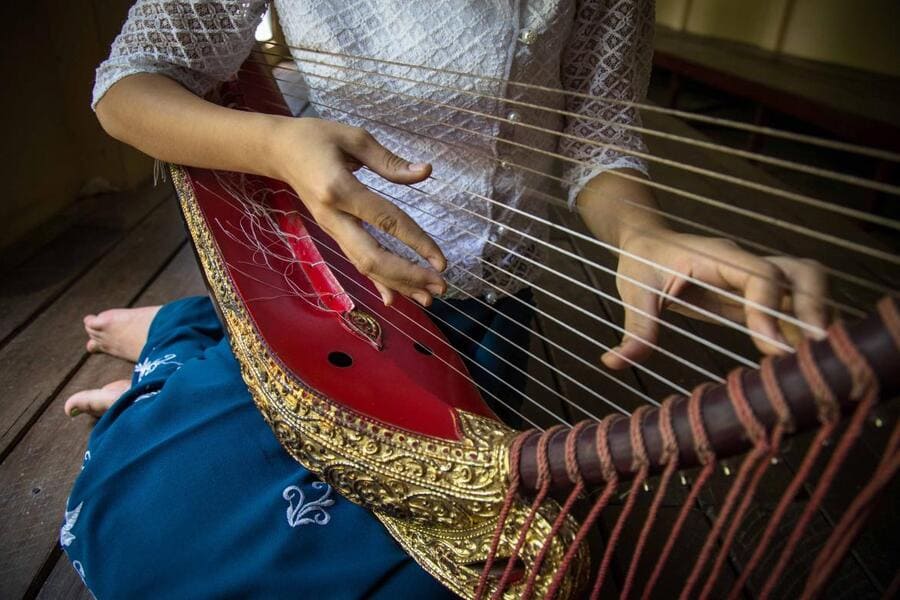
Playing the Saung Gauk is a physically intimate experience unlike playing most Western instruments. The musician sits cross-legged on the floor, resting the boat-shaped body in the lap with the curved arch pointing outward to one side. Rather than standing or sitting in a chair, this floor-seated posture is itself part of the tradition, tying the instrument closely to temple and court customs of sitting at floor level.
The right hand does the primary work of plucking, using the thumb and forefinger to pull the strings from the outside, producing the harp's signature warm, resonant tone. The left hand, meanwhile, plays a more nuanced supporting role: fingers dampen strings to keep the sound clean and precise, while the thumbnail presses against individual strings from the inside to subtly raise their pitch, a technique that allows the harpist to bend notes and add ornamentation impossible on a fixed-pitch instrument.
Because the harp has no frets, pedals, or fixed pitch-shifting mechanism like a Western concert harp, mastering these microtonal bends and the precise coordination between hands takes years of dedicated practice. Traditional performance also requires the harpist to follow the rhythm set by hand cymbals called si and wooden clappers called wa, often while accompanying a vocalist performing pieces from the Mahagita repertoire.
What Does the Saung-Gauk Sound Like?
Distinctive musical characteristics
The sound of the saung-gauk is often described by listeners as gentle, shimmering, and slightly melancholic, with a natural decay that lets each plucked note bloom and fade organically. Because the strings are traditionally made of silk rather than metal or gut, the tone has a softer, rounder quality compared to Western harps, lacking the bright metallic edge that steel strings produce.
The instrument's tuning systems are based on traditional Burmese modes originally derived from oboe music, giving performances a distinctly Southeast Asian melodic character that does not map neatly onto Western major or minor scales. Combined with the left-hand pitch-bending technique, this creates fluid, ornamented phrases that flow more like sung speech than mechanically fixed notes, which is part of why the Saung Gauk pairs so naturally with vocal performance.
Comparison with other Asian harps
While arched harps once existed across parts of Asia, most of these traditions declined or disappeared over the centuries, leaving the Burmese saung as the region's last continuously played example. Compared to instruments like the Chinese guzheng or Japanese koto, which are zithers with strings running parallel over a flat board, the Saung Gauk is structurally distinct as a true harp, with strings running at an angle from body to neck rather than across a flat surface. This fundamental design difference gives it a more resonant, open-air acoustic quality, and its continued survival is precisely why scholars and museums, including the Metropolitan Museum of Art and the Royal Collection Trust, treat surviving examples as significant cultural artifacts.
Where Can You Listen to or See a Saung Gauk in Myanmar?
Travelers wanting a firsthand encounter with this instrument have several reliable options. In Yangon, traditional puppet shows and cultural dinner performances frequently feature live Saung Gauk accompaniment, offering visitors a relaxed, authentic introduction to the sound alongside classical Burmese dance.
In Mandalay, the former royal capital, cultural centers and marionette theaters continue the court tradition of pairing harp music with classical repertoire, and it is often possible to see instrument makers at work in nearby craft workshops. Myanmar's State Schools of Fine Arts, established to preserve classical music education after independence, remain an important institutional home for serious students of the instrument and occasionally host public recitals.
For museum enthusiasts, examples of the saung gauk myanmar craftsmen have produced over the centuries are held in major institutional collections abroad, including the Metropolitan Museum of Art in New York and the Royal Collection Trust in the United Kingdom, both of which document the instrument's construction and history in detail. Within Myanmar itself, cultural museums in Yangon and Mandalay display historic harps alongside explanations of their royal and religious significance, giving independent travelers a chance to study the instrument up close even outside of a live performance.
FAQs About the Saung Gauk
Is the Saung Gauk difficult to learn?
Yes, genuinely mastering the Saung Gauk takes years of consistent practice. While the basic plucking technique with the right hand can be picked up relatively quickly, coordinating the left-hand string dampening and pitch-bending technique, along with learning traditional modes and repertoire, requires long-term study, typically under a trained teacher.
How many strings does a Saung Gauk have?
Historically the number of strings ranged from as few as five in early depictions up to eleven in older harps, before expanding to thirteen strings in the nineteenth century. Modern instruments most commonly have sixteen strings, a standard largely credited to twentieth century harpist U Ba Than, though some contemporary makers still build fourteen-string versions.
Can tourists buy a Saung Gauk in Myanmar?
Yes, both decorative souvenir versions and fully playable, handcrafted instruments are available for purchase in cities like Yangon and Mandalay. Buyers seeking an authentic playable saung gauk instrument rather than a decorative piece should work with a reputable craft workshop or ask a trusted local guide for a recommendation, since quality and pricing vary widely between vendors.
Is the Saung Gauk still used today?
Yes, the instrument remains actively played in Myanmar, both in formal classical settings such as the State Schools of Fine Arts and in more casual tourist-facing cultural performances, puppet shows, and traditional dinners. Cultural authorities have also been pursuing UNESCO recognition for the broader Mahagita tradition that the Saung Gauk belongs to, underscoring its ongoing relevance as a living, not merely historical, art form.